










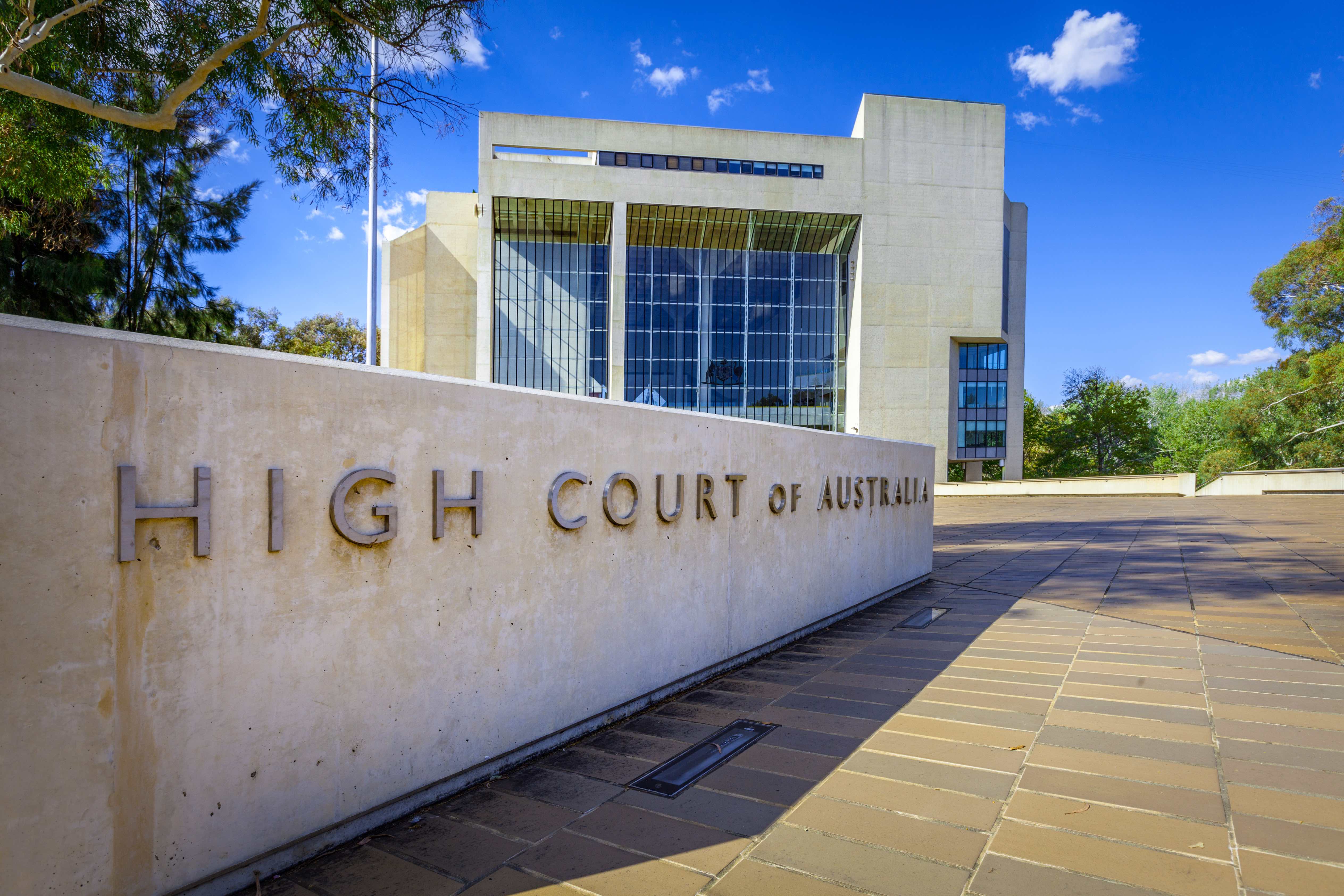
High Court. In YBFZ, cl 070.612A(1) of Schedule 2 to the Migration Regulations 1994 (Cth), imposing curfew and monitoring conditions, was declared unconstitutional. That provision was then amended, but continued to impose those conditions in essentially the same form. Is the new cl 070.612A(1) also unconstitutional?
In YBFZ, the High Court ruled that cl 070.612A(1) of Schedule 2 to the Migration Regulations 1994 (Cth), as it then stood, was penal or punitive, and not reasonably capable of being seen as necessary for a legitimate and non-punitive purpose, therefore being uconstitutional.
That provision imposed some conditions to the grant of a BVR, including the following:
Condition 8620, subclause (1) of which read: "The holder must, between 10 pm on one day and 6 am the next day or between such other times as are specified in writing by the Minister, remain at a notified address for the holder for those days". This is hereafter referred to as the "curfew condition".
Condition 8621, subclause (1) of which read: "The holder must wear a monitoring device at all times.". This is hereafter referred to as the "monitoring condition".
Clause 070.612A(1) was then changed to read that, for each the monitoring condition and the curfew condition, the Minister must impose the condition if:
(a) ...
(b) ... the Minister is satisfied on the balance of probabilities that the holder poses a substantial risk of seriously harming any part of the Australian community by committing a serious offence; and(c) the Minister is satisfied on the balance of probabilities that the imposition of the condition (in addition to the other conditions imposed by or under this subclause or another provision of this Division) is:
(i) reasonably necessary; and
(ii) reasonably appropriate and adapted;
for the purpose of protecting any part of the Australian community from serious harm by addressing that substantial risk."
The following definition was contained in cl 070.111:
serious offence means an offence against a law of the Commonwealth, a State or a Territory where:
(a) it is an offence punishable by imprisonment for life or for a period, or maximum period, of at least 5 years; and
(b) the particular conduct constituting the offence involves or would involve:
(i) loss of a person’s life or serious risk of loss of a person’s life; or
(ii) serious personal injury or serious risk of serious personal injury; or
(iii) sexual assault; or
(iv) the production, publication, possession, supply or sale of, or other dealing in, child abuse material (within the meaning of Part 10.6 of the Criminal Code); or
(v) consenting to or procuring the employment of a child, or employing a child, in connection with material referred to in subparagraph (iv); or
(vi) acts done in preparation for, or to facilitate, the commission of a sexual offence against a person under 16; or
(vii) domestic or family violence (including in the form of coercive control); or
(viii) threatening or inciting violence towards a person or group of persons on the ground of an attribute of the person or one or more members of the group; or
(ix) people smuggling; or
(x) human trafficking.
As was the case at the time of the judgment in YBFZ, r 2.25AE(1) of the Regulations provided that, if the curfew or monitoring conditions, among others, were imposed on a BVR: "the visa is subject to those conditions for a period of 12 months from the day the visa is granted".
The two subclauses above (for each condition) remained the same.
Some of the questions to the High Court (HCA) were as follows:
Question 1: Is the constitutional limitation identified in Lim that a "Commonwealth law purporting to impose a detriment of a nature and severity which warrants prima facie characterisation as penal or punitive, other than through the exercise by a court of the judicial power of the Commonwealth in the performance of the function of adjudging and punishing criminal guilt, will contravene Ch III of the Constitution unless the law is reasonably capable of being seen to be necessary for a legitimate and non-punitive purpose"?
Question 2: Can it be said that "the only difference between a citizen and an alien in the application of the constitutional limitation identified in Lim lies in the susceptibility of an alien to a law that is reasonably capable of being seen as necessary for one or other of two non-punitive purposes: removal from Australia; or enabling an application for permission to remain in Australia to be made and considered"?
Question 3: Was the purpose of protection of any part of the Australian community from a substantial risk of harm set out in (b)(i)-(vi) of the definition of "serious offence" legitimate and non-punitive?
Question 4: Is the purpose referred to in Question 3 rendered constitutionally illegitimate by reason it is pursued by cl 070.612A(1) solely in respect of the risk of harm that is posed by NZYQ affected persons?
Question 5: Does the new cl 070.612A(1) fails the test of reasonable necessity to achieve the identified purpose of their imposition?
Question 6: Is a person's alien status "constitutionally irrelevant to whether the deprivation of liberty and interference with bodily integrity is justified"?
Question 7: Can it be said that "the requirement to wear certain types of clothing to prevent others from seeing the monitoring device, irrespective of the appropriateness of that clothing to the weather or circumstances, is a further encroachment on the personal liberty of the individual"?
Question 8: Can it be said that "there is an interference with bodily integrity and deprivation of liberty resulting from the electronic monitoring condition which is, "by reason of [its] nature or because of historical considerations", prima facie punitive"?
Question 9: Is the power to impose the curfew condition a power of "detention", a deprivation of liberty, in the sense in which that word was used in Lim?
Question 10: Can it be said that, "that the visa holder poses the relevant risk, and that the imposition of the impugned condition is reasonably necessary and reasonably appropriate and adapted, as opposed to the Minister's satisfaction on the balance of probabilities as to those facts, are not objective jurisdictional facts for the purposes of judicial review"?
Question 11: Can it be said that, "since the home detention and monitoring conditions of the Amended Regulation are punitive, no issue arises as to whether the means adopted by the Amended Regulation in imposing the home detention and monitoring conditions are reasonably capable of being seen as necessary for a legitimate and non-punitive purpose"?
The HCA answered those questions as follows: